
FULL HTML
ELECTRONIC JOURNAL OF SOCIAL AND STRATEGIC STUDIES - Volume 7 Special Issue 1, July 2026
Pages: 101-130
Print Article Download XML Download PDF
Unravellling Military Strategies of the Kurukshetra War
Avani Ajey Dhakras
Category:Strategic Studies
Abstract:
The study of ancient military history is crucial for a comprehensive understanding of the military character of the nation. These texts have the potential to not only offer timeless strategic principles but can also succour in development of doctrines. This research undertakes the study of the Kurukshetra War, as detailed in the Mahabharata. The battle was fought between the well-organised armies of the Kauravas and Pandavas. Transcending a mere clash of numbers, the Kurukshetra War reflected the progression from Dharma-Yuddha (righteous war) to Kuta-Yuddha (deceptive war) as the stakes for the survival of the clan intensified. Cardinal to the military brilliance of the Kurukshetra War were the Vyuhas – military formations – and the use of targeted asymmetric warfare. These military formations displayed a highly disciplined command and control structure, as each formation required a synchronised movement amongst infantry, cavalry and chariots. The use of these tactics illustrates how complex and multi-layered responses were designed for tackling specific battlefield threats. The war is also marked by the use of unconventional tactics by employing psychological operations to neutralise important targets. The synergy between traditional defensive strength and asymmetric warfare signifies that war has layers. By unravelling the layers of the Kurukshetra War in the context of tactical decoding, strategic evolution and modern relevance, the purpose of this study is to gain a timeless template for understanding war through the lens of the Kurukshetra War as written in the Mahabharata.
Keywords: Kurukshetra War, Mahabharata, warfare, strategy, tactics, non-kinetic, military
Full Text:
Introduction
Wars are not a new occurrence. History is proof that wars are an inexorable phenomenon. Numerous battles and wars have been fought since man has existed. The human desire for power leads to the inevitable recurrence of wars. This relentless pursuit of power to procure interests widens rifts. Consequently, the doors for reconciliation close, eventually resorting to war for the objective to be achieved.
With the dynamic advancements in the landscape of warfighting, it is pertinent for states to develop strategies that are continuous. Although the nature of warfare has evolved with time, the fundamental axioms remain unchanged. Various military strategies and doctrines were postulated as chapters in military history progressed. These doctrines were formulated through scientific inquiry and academic research of wars by gaining insights from the episodes of past. With that said, history serves as a substantial means to conceive military strategy. States devise their military doctrines and strategies on the basis of their respective strategic culture. Ancient texts on warfare and strategy have the potential to offer valuable insights into the same and contribute to the study of the military history of a nation. There are numerous ancient Indian texts that cover the subjects of warfare, statecraft and strategy. The Mahabharata is one such timeless and eclectic text that narrates the legendary Kurukshetra war. The spectrum of this episode in history encompasses a variety of standpoints on war and strategy. Incorporating lessons from the Kurukshetra war can prove to be relevant to contemporary military doctrines. The Kurukshetra War, composed by the use of conventional as well as unconventional strategies, seems comparable to today’s era of wars.
Aim
The aim of this research is to analyse the military stratagems of the Kurukshetra War and evaluate their efficacy and relevance to modern warfare. The research further intends to explore whether parallels with contemporary concepts can be drawn in order to bridge the gap between ancient Indian military science and modern strategic thought.
Methodology
The study of this paper is based on the practices of the secondary method of data collection. Reliance on secondary sources like scholarly journals, academic articles, reputed commentaries and books, to gather relevant information has been made to ensure that the analysis presented in the paper is rooted in validated and well-established knowledge.
Background: Context of the Kurukshetra War
The epic of the Mahabharata details the Kurukshetra War between the Pandavas and the Kauravas. It was a clash of two clans for succession. The Mahabharata is a grand piece of literature that showcases a fusion of the virtuous and the wicked, depicting the stark reality of human character and nature. The central theme of the text revolves around the power struggle and roots of resentment between two groups of first cousins that advanced to a point of no return after failed peace-keeping efforts. As a consequence, war was the only remaining option. The rivalry escalated into a global conflict, which witnessed the participation of nearly all the kingdoms of the era. The two clans involved were the Pandavas and the Kauravas. The Pandavas were the five sons of King Pandu. They were Yuddhishthira, Bhima, Arjun, Nakul and Sahadeva, being the youngest. The Kauravas were the 100 sons of King Dhritarashtra, led by the eldest, Duryodhana. Although they grew up together, they were aware of disputed claims over the throne. Over the decades, the root of resentment grew deeper due to several incidents like multiple assassination attempts on the Pandavas and the rigged game of dice, which lost the Pandavas their freedom, their wealth and their kingdom. The ultimate humiliation was that of Draupadi, the wife of the Pandavas, which transformed the political dispute into a pledge of vengeance. Prior to the war, a lot of diplomatic and peacekeeping efforts were undertaken through mediation by Krishna. However, the complete negation of proposed negotiations to resolve the dispute led to the beginning of the devastating war. Finally, the war lasted for 18 days, and the Pandavas emerged victorious.
Structure and Composition of the Armies
The following information is based on inferences drawn from the seminal works by Major P. Sensarma (Sensarma, Kurukhetra War: A Military Study, 1975), Uma Prasad Thapliyal (Thapliyal, 2021), Major General G.D Bakshi (Bakshi, 2024), Brig K Kuldip Singh (Singh, 2013)
In the Kurukshetra War, a total of 18 Akshauhini sena (armies) fought. Akshauhini was the yardstick of the armed forces (Sensarma, Kurukhetra War: A Military Study, 1975). The Pandavas had 7 Akshauhini sena in opposition to the Kauravas, who had a staggering 11 Akshauhini sena. The armies had an organised structure and a precise, unambiguous command and control. The Akshauhini sena was composed of four elements, namely,
1. Padatee (infantry)
2. Ashwa (cavalry)
3. Gaja (soldier mounted on an elephant)
4. Ratha (soldier seated on a chariot)
Each Akshauhini sena was further divided into units and sub-units in an organised manner. The composition of the Akshauhini sena in a descending order of unit strength is described in the table given below.
Table 1: Composition of the Akshauhini Sena
|
Unit |
Unit Strength (No. of soldiers) |
Sub-units |
|
1 Akshauhini |
218700 |
10 Aneekinis |
|
1 Aneekini |
21870 |
3 Camus |
|
1 Camu |
7290 |
3 Prtinas |
|
1 Pritna |
2430 |
3 Vahinis |
|
1 Vahini |
810 |
3 Ganas |
|
1 Gana |
270 |
3 Gulmas |
|
1 Gulma |
90 |
3 Senamukhas |
|
1 Senamukha |
30 |
3 Pattis |
|
1 Patti |
10 |
- |
Source: By Author
This composition and structure of the Akshauhini sena has a semblance to contemporary armies organised into a well-defined structure of corps, divisions, brigades, battalions, and so on.
Analysing the strategic and tactical principles from the Kurukshetra War.
The Kurukshetra War witnessed immense prowess on the battlefield. Both the camps relied on battle formations to achieve strategic superiority. Coordinated manoeuvres were executed to facilitate either defensive consolidation or an offensive strike as the circumstances evolved. In ancient India, vyuhas (arrays) were commonly deployed on the battlefield (Thapliyal, 2021). They were an instrumental part of battle planning, making them a device of great ingenuity. Vyuhas are sophisticated military formations intended and designed to magnify specific strengths of the military and capitalise on the opponent’s vulnerabilities (Sensarma, Kurukhetra War: A Military Study, 1975). Vyuhas are formed through the incorporation of geometric patterns of various units. These units – Padatee, Ashwa, Gaja and Ratha – are organised into a dynamic and cohesive structure that resembles geometric patterns of various elements. These arrays have the competence to transform a massive, cumbersome force into an agile and responsive apparatus.
Major General G.D. Bakshi mentions in his book (Bakshi, 2024): …the geometrical organisation of the Vyuha restricted the tactical options open to the enemy to a few predictable responses.
This implies that the vyuhas helped devise a tenacious and controlled riposte to specific situations. These synchronised battle arrays were mainly constituted of four parts (Sensarma, 1975) (Bakshi, 2024)
1. Paksha (two frontal wings)
2. Untsua (centre)
3. Pratigraha (rear end)
4. Kaksha (two wings at the back)
This suggests that the vyuhas were methodical and precise. They ensure concern for flank and rear protection (Bakshi, 2024).
This section focuses on the comprehensive analysis of the vyuhas and outline their significance. The following analysis of the vyuhas has been made after applying contributions from Major P. Sensarma (Sensarma, Kurukhetra War: A Military Study, 1975), Major General G.D. Bakshi (Bakshi, 2024) and Uma Prasad Thapliyal (Thapliyal, 2021) and by critically examining the verses from the Critical Edition of Mahabharata compiled by V.S. Sukthankar (BORI) (Sukthankar, 2001) and referencing the English translations of The Mahabharata by M.N. Dutt (Dutt, 2022) and Kisari Mohan Ganguly (Ganguly, 2023). The following are the types of vyuhas that were extensively used in the Kurukshetra War:
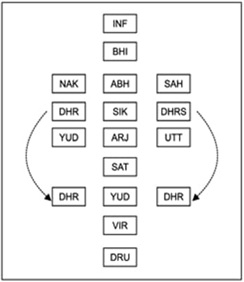
Figure 1: Vajra Vyuha
Source: (Thapliyal, 2021)
एष व्यूहामि ते राजन्व्यूहं परमदुर्जयम्॥6.19.007॥
अचलं नाम वज्राख्यं विहितं वज्रपाणिना (Sukthankar, 2001)
O foremost of kings, that immovable Vyuha called Vajra which was designed by the wielder of thunderbolt (Indra), that impenetrable vyuha I shall make today (Dutt, 2022)
Vajra Vyuha: The above verse mentions the formation of Vajra vyuha by the Pandavas. It resembled the shape of the weapon of Indra. This formation was applied, taking into consideration the lesser strength of the Pandavas. The tactical intent of the Vajra vyuha was to create an impenetrable defence. The formation permitted visual clarity and consolidation of strength (Sensarma, Kurukhetra War: A Military Study, 1975). The design of this formation allowed the warriors to strike the adversary with the element of surprise, like a thunderbolt at a specific point in the enemy line. It showcased the concentration of power. The flanks were narrow, and the rear was formed by a column of elephantry (Sensarma, Kurukhetra War: A Military Study, 1975).
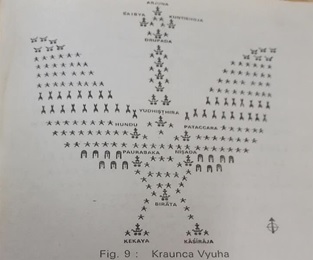
Figure 2: Krauncha Vyha
Source: (Sensarma, 1975)
तमब्रवीत्ततः पार्थः पार्षतं पृतनापतिम्॥6.46.039॥
व्यूहः क्रौञ्चारुणो नाम सर्वशत्रुनिबर्हणः (Sukthankar, 2001)
When the chastiser of foes, that foremost of prince, that descendant of Pritha (Dhrishtadyumna) defiantly spoke thus, the Pandava warriors, who were all greatly powerful, who were all incapable of being defeated, sent forth a loud shout. Then the son of Pritha, Yudhishthira, thus spoke to the descendant of Prishat (Dhrishtadyumna), the commander of his army, “A vyuha called Krauncharuna which is destructive of all foes.” (Dutt, 2022)
Krauncha Vyuha: 'Krauncha' means a heron-like bird in Sanskrit (Bakshi, 2024). The description, it implies that the formation was in the shape of a bird with a pointed beak. Modelled by replicating the anatomy of a bird, the formation comprised a long central column at the preceding side, two forward-facing curved wings, a medium-sized body, two small legs facing behind, and a bulged portion connecting the legs with the body (Sensarma, Kurukhetra War: A Military Study, 1975). The formation is designed for agility in movement. This array has a very tactical structure. The sharp beak-like structure on the frontal side allows it to break the initial line of the adversary. The head supports the core stability of the beak. The troops positioned with their eyes on either side of the head signify monitoring of the adversaries’ flanks. The wings are made of extensive flanking divisions that stretch out wide enough to trap and envelop the adversary in a pincer movement. The aim of designing this vyuha was to portray aggression and might. Distinguished by its balance of reach and penetration, the formation could sustain several hours of combat like the flight of a bird, shifting weight and pressure from one wing to another.
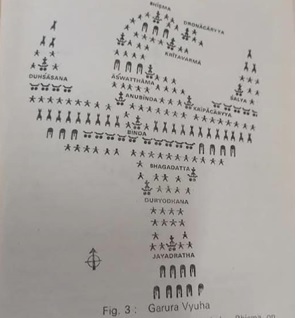
Figure 3: Garuda Vyuha
Source: (Sensarma, 1975)
गारुडं च महाव्यूहं चक्रे शांतनवस्तदा॥6.52.002॥
पुत्राणां ते जयाकाङ्क्षी भीष्मः कुरुपितामहः (Sukthankar, 2001)
The chastiser of foes, the son of Shantanu, with desire to win victory for your son formed that great vyuha called Garuda. (Dutt, 2022)
Garuda Vyuha: 'Garuda' is a Sanskrit word for the bird, the eagle. This formation takes the shape of an eagle. Garuda vyuha is distinct because each section has a specific combat role. The beak is supposed to act as a kinetic penetrator in the formation or the vanguard of the array (Thapliyal, 2021). It paves the way for a narrow front breakthrough, fixing the enemy in place. The head provides room for command control as well as an overview of the entire troop movement. The eyes in the formation provide lateral defence. The massive wings are designed to spread out wide for surrounding and enclosing the enemy troops (Sensarma, Kurukhetra War: A Military Study, 1975). This offensive-heavy formation has high mobility and is often intimidating for the opponent.
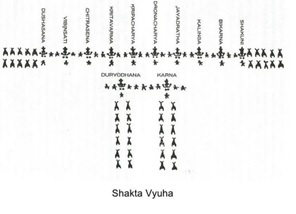
Figure 4: Shakata Vyuha
Source: (Sensarma, 1975)
अस्माकं शकटव्यूहो द्रोणेन विहितोऽभवत्॥7.6.015॥
परेषां क्रौञ्च एवासीद्व्यूहो राजन्महात्मनाम्
प्रीयमाणेन विहितो धर्मराजेन भारत (Sukthankar, 2001)
As regards our army, it was arrayed by Drona in the form of a Sakata (vehicle); while the array of our illustrious foes, O king, was in the form of a Krauncha (crane), as disposed, O Bharata, by king Yudhishthira the just in great cheerfulness. (Ganguly, 2023)
Shakata Vyuha: It is a T-shaped formation that resembles a cartwheel that is fitting to advance into the opponent's camp (Bakshi, 2024). The vyuha is described as broad, with a strong foundation and a front that is tapering. It can be inferred that it is an offensive-defensive formation. The two wings, on the left and right sides, were constituted of cavalry, while the central axis was formed by deploying troops in two columns (Sensarma, Kurukhetra War: A Military Study, 1975). The formation gives a dense impression to the adversary, which makes it difficult to penetrate and has the tactical capacity to resist shock and awe. This formation's primary goal is endurance. The front was limited in range and massively armoured to advance through the enemy post, like the bow of a ship. The intent of the central section is to protect the target from being struck by the enemy.
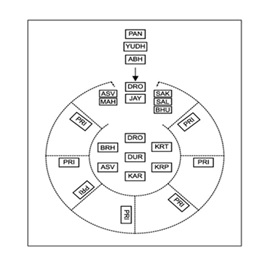
Figure 5: Ardhachandra Vyuha
Source: (Sensarma, 1975)
व्यूढं दृष्ट्वा तु तत्सैन्यं सव्यसाची परंतपः॥6.52.010॥
धृष्टद्युम्नेन सहितः प्रत्यव्यूहत संयुगे
अर्धचन्द्रेण व्यूहेन व्यूहं तमतिदारुणम् (Sukthankar, 2001)
The chastiser of foes, Savyasachi (Arjuna) seeing the enemy’s troops formed into a vyuha, with the assistance of Dhrishtadyumna formed his troops into a counter vyuha. In opposition of your vyuha, that son of Pandu formed a vyuha after the shape of the half-moon. (Dutt, 2022)
Ardhachandra Vyuha: As the name suggests, this formation mimics the shape of a half-crescent moon (Sensarma, Kurukhetra War: A Military Study, 1975). The Pandavas operated the use of this vyuha as a counter to the Garuda vyuha. The array has a solid centre with two extended and forward-reaching sharp tips. This formation was pertinent to gain tactical advantage because of its ability to envelop and reach around enemy flanks. The concave-shaped centre consisted of heavy infantry and cavalry intended to be a zone where the enemy could be trapped. Ardha-Chandra is a counteroffensive array since the primary aim or tactical significance of its conception is to engulf the enemy (Bakshi, 2024). The strategic brilliance behind this vyuha is to wait for the enemy’s force and consequently close around it.
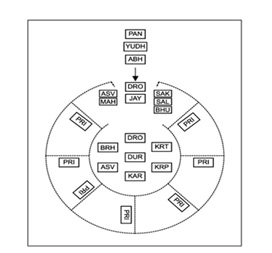
Figure 6: Chakra Vyuha
Source: (Thapliyal, 2021)
तं चाभिमन्युर्वचनात्पितुर्ज्येष्ठस्य भारत॥7.32.018॥
बिभेद दुर्भिदं संख्ये चक्रव्यूहमनेकधा (Sukthankar, 2001)
Then, O Bharata, at the command of his father’s eldest brother, Abhimanyu penetrated in that battle, into that impenetrable circular (concentric circles) array figuring the discus. (Dutt, 2022)
Chakra Vyuha: It is a circular formation that provides all-around protection (Bakshi, 2024). It is equipped to serve all-around defence. Also known as Padhma-vyuha, this formation mirrors the shape of a circular maze. The Chakra-Vyuha is a complex, multi-tiered array comprising concentric circle which are not static. The point of entrance is constantly shifting because of motion. The opponent is encountered with a continual attack as it tries to infiltrate deeper as a result of the rotation of the circles (Sensarma, Kurukhetra War: A Military Study, 1975). It is a classic example of entrapment strategy, as the guided entry inside the array masks the death trap. The opponent is disoriented from its own army as the outer ring closes point of entry as a result of rotation, resulting in loss of sense of navigation. It causes fatal fatigue to the infiltrator by the time the centre of the circle arrives. The strategic intent is to exhaust the enemy and create a kill zone that is impossible to escape (Thapliyal, 2021).
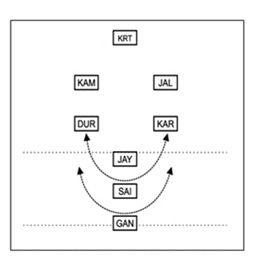
Figure 7: Suchimukha Vyuha
Source: (Sensarma, Kurukhetra War: A Military Study, 1975)
पश्चार्धे तस्य पद्मस्तु गर्भव्यूहः सुदुर्भिदः॥7.63.023॥
सूची पद्मस्य मध्यस्थो गूढो व्यूहः पुनः कृतः (Sukthankar, 2001)
In the back portion of the array was formed another impenetrable array figuring a lotus. Within this, latter again was constructed another closely formed array that was designed like the needle. (Dutt, 2022)
एवमेतं महाव्यूहं व्यूह्य द्रोणो व्यवस्थितः॥7.63.024॥
सूचीमुखे महेष्वासः कृतवर्मा व्यवस्थितः (Sukthankar, 2001)
Thus, having formed this mighty array Drona waited for the encounter. In the rear of the needle array was placed, Kritavarman, the fierce bowman. (Dutt, 2022)
Suchimukha Vyuha: This vyuha consisted of an elongated column and a small head (Bakshi, 2024). It duplicates the shape of a needle. Suchimukha-vyuha is an extremely concentrated array that paves the way for elite warriors to act as a kinetic penetrator because of the sharp needle point. The body of the formation is a dense composition of infantry and cavalry. The wider end accommodates reinforcements and allows rear protection. Its tactical significance lies in its role as an offensive manoeuvre designed to create a fracture at a specific microscopic point, allowing room for deep-strike capabilities (Sensarma, Kurukhetra War: A Military Study, 1975).
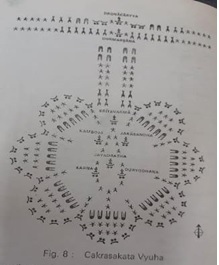
Figure 8: Chakrasakata Vyuha
Source: (Sensarma, 1975)
दीर्घो द्वादशगव्यूतिः पश्चार्धे पञ्च विस्तृतः॥7.63.021॥
व्यूहः स चक्रशकटो भारद्वाजेन निर्मितः (Sukthankar, 2001)
The array that the son of Bharadavaja then formed, partly figuring a Sakata and partly figuring a circle, was full forty-eight miles in length, and its back portion, in width, measured full twenty miles. (Dutt, 2022)
ChakrasakataVyuha: This formation was unique, characterized by its hybrid combination of a Chakra (circle) and Sakata (cart). The anterior side mirrors Sakata, and the posterior section mimics the Chakra. It is a deceptive formation because of its ability to be perceived as a mirage of manageable infiltration, only to be later trapped by the vortex of rotating circles. Its tactical goal is containment which is achieved through cutting off the line of retreat after reaching the section of Chakra (Sensarma, Kurukhetra War: A Military Study, 1975).
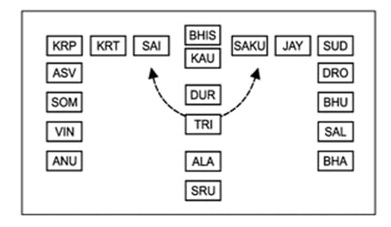
Figure 9: Sarvatobhadra Vyuha
Source: (Thapliyal, 2021)
ततः शांतनवो भीष्मो निर्ययौ सेनया सह॥6.95.026॥
व्यूहं चाव्यूहत महत्सर्वतोभद्रमाहवे (Sukthankar, 2001)
Thereafter, Bhishma, the son of Shantanu, advanced with his troops; and he formed his own troops in the mighty array called Sarvatobhadra. (Dutt, 2022)
Sarvatobhadra Vyuha: This is a defensive formation, which means safe from all sides. Its high density is the vyuha’s distinguishing element. It is designed to depict a fortress or square-like structure that is secure from all sides. It takes the shape of a resilient square, which is extremely resistant to invasion. It has anti-flanking capabilities as a result of the perimeter being impenetrable because of heavy deployment of infantry and cavalry. The central section of the vyuha houses the high value target, protected by multiple layers (Sensarma, Kurukhetra War: A Military Study, 1975).
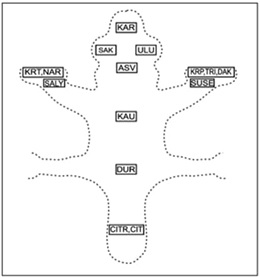
Figure 10: Makara Vyuha
Source: (Thapliyal, 2021)
अरक्षन्मकरव्यूहं भीष्मो राजन्समन्ततः॥6.65.004॥
तथैव पाण्डवा राजन्नरक्षन्व्यूहमात्मनः (Sukthankar, 2001)
O Monarch, Bhishma protected on all sides the array of his troops that figured the Makara. O King, so also, the sons of Pandu protected the array that they had formed with their troops. (Dutt, 2022)
Makara Vyuha: The Makara vyuha is an offensive array (Sensarma, Kurukhetra War: A Military Study, 1975). This vyuha moulds itself the shape of a crocodile. This is a heavy assault formation that exhibits frontal pressure. The front of the vyuha is a highly concentrated section comprising chariot warriors and cavalry. The body of the vyuha is also wide and dense, protected by the four divisions (feet) on the sides. The rear end has the ability to swing around to ward off attacks from behind.
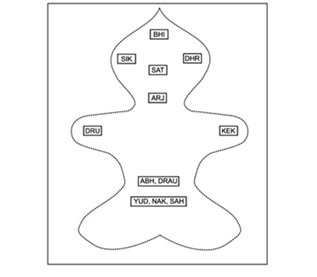
Figure 11: Syena Vyuha
Source: (Thapliyal, 2021)
तान्दृष्ट्वा प्रोद्यतान्संख्ये पाण्डवाश्च यशस्विनः॥6.65.007॥
श्येनेन व्यूहराजेन तेनाजय्येन संयुगे (Sukthankar, 2001)
And beholding them prepared for battle, the illustrious sons of Pandu arrayed their troops in that invincible and prince of arrays called the Syena (Ganguly, 2023).
Syena Vyuha: It is a slight modification of the Krauncha Vyuha (Sensarma, Kurukhetra War: A Military Study, 1975). The formation’s wings are wider, though less extended, and the neck is short but thick. The body is comparatively longer. This formation paves the way for a more consolidated deployment of the soldiers. It is designed for defensive and offensive attacks (Sensarma, Kurukhetra War: A Military Study, 1975).
Armies were always deployed in arrays and formations whenever a battle was to be fought. After careful consideration of the circumstances, tactical goals and adversary’s strength, the choice of array to be formed was made by the senior commanders who were extensively versed with the principles of war. In grave situations that required dynamic responses, mixed arrays were formed. These vyuhas had the ability to revolutionize the battlefield by allocating the mass of soldiers into responsive forms and shapes that have the capacity to augment the strength of individual units. These were sophisticated mechanisms crafted to be force multipliers. The nodes of the formations were usually guarded by elite warriors, who acted as bursts of power. At the same time, the quantum of infantry that made up the body of the formation provided the structural stability. Consequently, leading the way for the maintenance of cohesion in the midst of the chaos of the battlefield. The king or the main target remained shielded by the layers of units. The blend of strategic positioning with the tactical shapes represented the pinnacle of ancient combat.
The following section of the paper will assess the relevance of these vyuhas by comparing them with modern, standardized configurations found in contemporary military field manuals.
Formations in Contemporary Military Field Manuals
The following section will cover the study of various tactical battle formations given in the U.S. Army Tactical Manual (US Department of Army, 2013) and some manoeuvres employed by the German Army in World War II (Citino, Beyond Fire and Movement: Command, Control and Information in the German Blitzkrieg, 2004), although dated, and evaluate their resemblance to the formations exercised in the Kurukshetra War. Example from World War II has been referred because of its tactical resemblance to the vyuhas in Mahabharata to infiltrate enemy lines in a ground invasion.
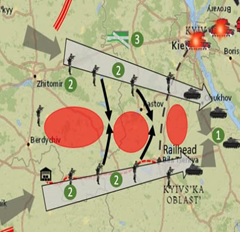
Figure 12: Blitkreig
Source: (World War 2 Clash)
Blitzkrieg
Blitzkrieg was the surprise combined-arms attack used by the German army during the invasion of France. The German armoured troops were organized in a needle-like, spearheaded shape with a narrow point to penetrate deep into the enemy lines. It prioritised concentrated force, channelizing speed and surprise instead of a broad, slow-moving front. This coordinated attack made use of infantry, tanks and close air support. The armoured divisions made up the frontal part of the formation. The air support (Luftwaffe) ensured disruption of communication lines, and the piercing severely collapsed the enemy’s defensive system and also attacked the operational rear (Citino, Beyond Fire and Movement: Command, Control and Information in the German Blitzkrieg, 2004). To note another example, Robert Citino, in his book titled ‘Blitzkrieg to Desert Strom: The evolution of Operational Warfare’ writes that the 1971 Indo-Pakistani War was a blitzkrieg integrated into South Asian conditions (Citino, 2004)
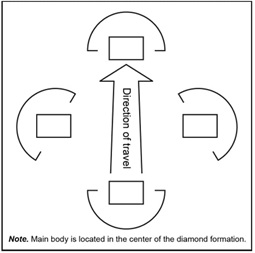
Figure 13: Diamond Formation
Source: (US Department of Army, 2013)
Diamond Formation
The diamond formation distributes its elements on all sides of the rhombus. Consequently, protection from all sides is ensured as the armoured soldiers are outward-facing and orientated towards the threat. It changes easily and quickly to another formation (US Department of Army, 2013). The core remains protected due to 360-degree security, which houses the squad leader. The formation is conducive to speed of movement to strike with a surprise without shifting the body of the troops (US Department of Army, 2013).
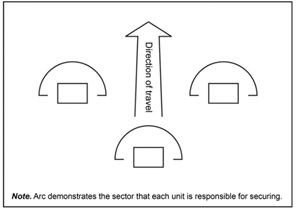
Figure 14: Vee Formation
Source: (US Department of Army, 2013)
Vee Formation
The Vee formation is composed of two elements ahead and one element guiding the centre (US Department of Army, 2013). The two frontal elements mimic horns that forces the enemy into the centre caught between two leading units. Hence a central kill-zone is created to tactically contain the adversary. This formation prioritizes frontal firepower and engagement in a continued manoeuvre (US Department of Army, 2013).
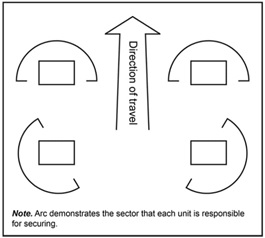
Figure 15: Box Formation
Source: (US Department of Army, 2013)
Box Formation
It is a hollow square-like formation where two elements lead, and the other two follow. This formation has four manoeuvre elements (US Department of Army, 2013). It provides well-rounded security. The shape allows the combat elements to mould into other formations easily with speed in movements. The firepower is concentrated in the frontal flanks (US Department of Army, 2013). This formation is favourable for defensive purposes, and the firepower is already headed and positioned towards the threat.
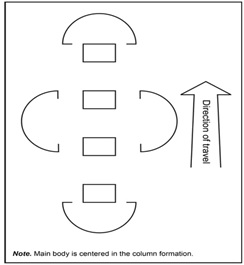
Figure 16: Column Formation
Source: (US Department of Army, 2013)
Column Formation
This is a movement formation with elements arranged one behind another (US Department of Army, 2013). Primarily, the column formation is employed for speed and control. This formation allows the lead unit to watch out for any suspicious movement or threat from the enemy. It provides room for considerable numbers of troops to move quickly. In the column formation, the other units give the push movement when the lead unit comes in contact with the enemy.
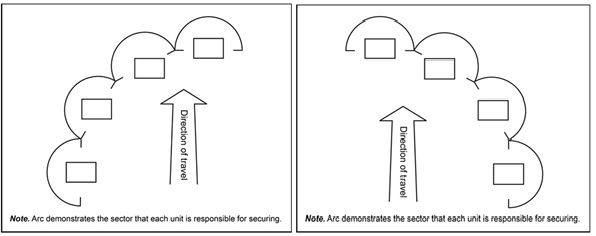
Figure 17: Echelon Formation
Source: (US Department of Army, 2013)
Echelon Formation
In echelon formation (left or right), the combat troops are positioned diagonally with each element to the rear and to the side of the unit in front (US Department of Army, 2013). It provides readiness for the field of targets to be enveloped with an attack, providing control. Since not all elements make contact simultaneously, it allows other units that are not in contact to manoeuvre against the enemy (US Department of Army, 2013).
Analysing the modern relevance of ancient vyuhas
A parallel association has been presented in the table below of the contemporary military formations, as given in the U.S tactical manual, to the complex geometrical arrays used in the battle of Kurukshetra. The exemplification of the two subjects’ reveals that the contemporary military formations are a modern evolution of the ancient timeless vyuhas. The vyuhas can be called the historical ancestors of the modern formations. Not unerringly, but the vyuhas resemble the primary vectors, strategic functions and tactical objectives of the modern formations.
Table 2: Comparative study of Vyuhas and Modern formations
|
Vyuha |
Modern Formation |
Structural Linkage |
Tactical Objective |
|
Suchimukha Vyuha |
Blitzkrieg |
A tapered, sharp, high impact point followed by a long column-like structure. |
Deep penetration by piercing through the front to strike the command centre. |
|
Ardha-chandra Vyuha |
Vee Formation |
Inclusive of the area of contact, it resembles a crescent front with two leading prongs and a caved in centre. |
To create a kill-zone to trap or funnel the adversary into getting locked into cross-fire. |
|
Sarvatobhadra Vyuha |
Box Formation |
Square like defensive array with troops oriented in the direction of all cardinal points. |
Creating impenetrable 360-degree security to protect valuable asset. |
|
Vajra Vyuha |
Diamond Formation |
A rigid block with a protected core and braced corners. |
Utilizing kinetic mass to indulge in crushing force during manoeuvre. |
|
Garuda Vyuha |
Column-Echelon Hybrid |
A central file (column) sustained by diagonal (echelons) deployment resembling wing-like arc because of the area of contact. |
Longitudinal security along with wide area flank protection for envelopment or sweep movement. |
Source: By author
The core strategic lessons from these vyuhas like concentrated breakthrough, overlapping encirclement, perimeter defence, double envelopment, multi-layered defence or offense can be translated into modern doctrine. This refinement of ancient stratagems to fit into modern principles by operationalising technology along with integration of commands can result into a dynamic ground strategy for modern battles. Although, infantry and cavalry, spears, chariots and arrows have been heavily replaced with technological advancements yet the core strategy remains consistent.
Non-kinetic military strategies employed in the Kurukshetra War
In wars, for attaining the objective and securing interests, every tool at disposal is employed. In tandem with the military strategies, non- kinetic military strategies like psychological warfare, moral subversion, coercion, espionage, and disinformation tactics are utilised to gain an edge over the adversary. Often subscribed to as modern doctrines, the application of these strategies can be traced to the Kurukshetra War. The description below focuses on these non-military campaigns exercised in the Kurukshetra War. By drawing reasoning from information based on the Critical Edition of the Mahabharata compiled by V.S. Sukthankar (BORI) (Sukthankar, 2001) and English translations of the Mahabharata by M.N. Dutt (Dutt, 2022) and Kisari Mohan Ganguly (Ganguly, 2023) the following observations can be made:
Non-kinetic military strategies
This doctrine involves the planned use of manipulation, fear, and propaganda in order to influence the enemy’s actions (Basu, 2023). In the battle, Pandavas resorted to the use of psychological operations to neutralize critical and important targets.
Falling of Bhishma
शिखण्डिनं पुरस्कृत्य धनुश्चास्य समाच्छिनत्॥6.114.013॥
भीष्मस्य धनुषश्छेदं नामृष्यन्त महारथाः॥6.114.014॥ (Sukthankar, 2001)
And placing Shikhandin before him (Bhishma), he cut off the bow of the latter. Then the following seven mighty car-warriors did not brook that cutting off Bhishma’s bow (Dutt, 2022).
कारणद्वयमास्थाय नाहं योत्स्यामि पाण्डवैः॥6.114.032॥
अवध्यत्वाच्च पाण्डूनां स्त्रीभावाच्च शिखण्डिनः॥6.114.032॥ (Sukthankar, 2001)
I shall not fight with Pandavas for two reasons, viz., for the unslayableness of Pandavas and for the femininity of Shikhandin (Dutt, 2022).
Bhishma was blessed with a boon that made him physically invincible. He had taken a vow of refusal to fight with a female (Ganguly, 2023). Thus, the Pandavas exploited this vulnerability and made the decision to place Shikhandin in front of Bhishma on the battlefield. This classic psychological operation tactic resulted in Bhishma lowering his bow in front of his adversaries. It forced Bhishma to commit to his vow and give up his arms, allowing the Pandavas to strike him.
Disarming Drona
यथा वः संयुगे सर्वान्न हन्याद्रुक्मवाहनः॥7.164.068॥
अश्वत्थाम्नि हते नैष युध्येदिति मतिर्मम॥7.164.069॥ (Sukthankar, 2001)
Before Drona, drawn by horses of golden colours succeeds in slaying us all, if Ashwatthaman be killed, he will desist from fighting (Dutt, 2022).
अन्ये त्वरोचयन् सर्वे कृच्छ्रेण तु युधिष्ठिरः।
ततो भीमो महाबाहुरनीके स्वे महागजम्॥7.164.070॥
जघान गदया राजन्नश्वत्थामानमित्युत।
परप्रमथनं घोरं मालवस्येन्द्रवर्मणः॥7.164.071॥ (Sukthankar, 2001)
Others approved of it. Yudhishthira accepted it with much reluctance. Then the mighty-armed Bhima, O monarch, slew with his mace, a terrible prodigious and foe-crushing elephant called Ashvatthaman belonging to Indravarman the ruler of the Malavas (Dutt, 2022).
अश्वत्थामात हि गजः ख्याता नाम्ना हताऽभवत्।
कृत्वा मनसि तं भीमो मिथ्या व्याहृतवांस्तदा॥7.164.073॥ (Sukthankar, 2001)
The elephant known by the name of Ashvatthaman having been slain, Bhima spoke of Ashwatthama’s death. Knowing the true fact in his mind, Bhima then spoke what was false (Dutt, 2022).
अव्यक्तमब्रवीद्राजन्हतः कुञ्जर इत्युत॥7.164.106॥ (Sukthankar, 2001)
(Yudhishthira) Clearly said that Ashwatthama was dead, adding indistinctly the word elephant after the name (Dutt, 2022).
Drona’s source of moral and physical strength was his son. The Pandavas tactfully indulged in creating cognitive dissonance for Drona. They intentionally spread the rumour about the killing of Ashwatthama. Bhima provided the kinetic execution by killing the elephant named Ashwatthama. Refusing to believe the rumours, Drona decided to ask Yudhishthira, who was supposed to be the personification of truth. Yudhishthira confirmed the killing of Ashwatthama (by whispering ‘elephant’), by using a truth to tell a lie. This non-kinetic strike impacted the superior military commander, resulting in mental paralysis. Overpowered by grief, Drona gave up his arms and became defenceless. The Pandavas leveraged this situation to target Drona. (Ganguly, 2023)
Jayadratha’s Death
सृष्टे तमसि कृष्णेन गतोऽस्तमिति भास्करः॥7.121॥
त्वदीया जहृषुर्योधाः पार्थनाशान्नराधिप। (Sukthankar, 2001)
When Krishna had created that veil of darkness, thinking the sun to have set, your troops became delighted, O king, in view of the destruction of Pritha’s son Arjuna (Dutt, 2022).
ते प्रहृष्टा रणे राजन् नापश्यन् सैनिका रविम्॥7.121॥
उन्नाम्य वक्त्राणि तदा स च राजा जयद्रथः। (Sukthankar, 2001)
Highly delighted, O King, your troops and king Jayadratha could not see the sun though they all stood with their heads thrown back (Dutt, 2022).
Pandavas broke the combat rule and manipulated the code of time to defeat Jayadratha. Krishna created the illusion of a sunset to signal the cessation of combat to the Kauravas. Falling for the false sunset trap, the Kauravas let their guard down. The Pandavas tactfully used this as psychological bait to get Jaydratha exposed in line of sight. Once the illusion disappeared, Arjuna used his kinetic prowess to target Jayadratha (Ganguly, 2023).
Shalya’s Role
When Shalya agreed to become the charioteer of Karna, the intent was to sabotage Karna’s combat prowess. Shalya was acting as an agent of the Pandavas while serving the Kauravas' army. He engaged in repeated intellectual objection and psychological subversion to mock, erode, and target Karna’s focus to breakdown his morale. Shalya also displayed apathetic resistance when Karna pleaded for assistance to remove the chariot stuck in the pit. Arjuna took advantage of the opportunity when Karna stepped down defenceless to push the stuck chariot (Ganguly, 2023)
The following table has been formed based on the contributions from Col S Basu (Basu, 2023), M.N. Dutt (Dutt, 2022), V.S. Sukthankar (Sukthankar, 2001), Tahirov, Sadiyev and Sahanov (Tahirov, Sadiyev, Hasanov, & Hikmet, 2025), Rushing, Hersch and Xu (Rushing, Hersch, & Xu, 2026), and Dr. Nelson and Sgt. Maj. Pingel (Dr. Nelson, Pingel, & Benjamin, 2026). It provides an analytical explanation of the application of non-kinetic military strategies used in the Kurukshetra war in relation to the provided anecdotes along with contemporary illustrations.
Table 3: Analytical Study of non-kinetic military strategies
|
Anecdotes from Kurukshetra war |
Non-kinetic military strategy |
Purpose |
Modern military example |
|
Falling of Bhishma |
Cognitive warfare |
To degrade decision making, increase hesitation and constrain the available the courses of action |
Sophisticated information campaign directed by the Azerbaijani government during the Nagorno-Karabakh war in 2020 |
|
Disarming Drona |
Intimidation |
Disinformation campaign to gain tactical and strategic leverage |
ISPR’s Information warfare campaign against India during Operation Sindoor in May 2025 |
|
Jayadratha’s Death |
Intimidation |
Manipulating information environment |
During the 1971 war, Indian Army used calculated leaks and radio traffics, leading to the surrender of 93,000 Pakistani soldiers |
|
Shalya’s role |
Subversion |
Covert support to the adversary |
Russia’s long term covert support to PMCs operating in eastern Europe, west Asia and Africa |
Source: By Author
These non-kinetic military strategies encapsulate the essence of intelligence and information. The instances stated above from the Kurukshetra War make a case for how pertinent real time intelligence monitoring and information gathering is to gain leverage over the adversary. The Pandavas used an indirect approach through these non-kinetic tactics to exploit a superior target. The Kurukshetra War highlights the value of prioritizing tactics like psychological and information warfare using real-time intelligence to neutralize the targets. Lessons can potentially be drawn from these strategies into the military template of India. Application of those strategies through heavy investment in continuous intelligence monitoring, cyber-security and to counter disinformation campaigns can strengthen security in a hostile environment.
Conclusion
Warfare has tremendously evolved with time and technological advancements. It has been a layered phenomenon. Notwithstanding that, the basic principles and the foundational axioms from which the evolutionary road is constructed for modern doctrine to form for adaptability to dynamic environments remain the same.
This study takes the case of the Kurukshetra War to prove that modern warfare doctrines have been postulated by close alignment with their historical ancestors of ancient warfare. The paper carefully analysed the conventional military operations that persisted during the time of the Mahabharata. The detailed analogue of military formations and the tactical purpose behind them suggests that military science was a well-researched discipline with a practical temperament applicable on the battlefield. The vyuhas were employed with a specific goal. The vyuhas were dynamic and moulded easily from one formation to another depending upon the circumstances. Following this, the research analysed the modern military formations from the U.S Army Tactical manual and presented a parallel comparison of the two. Consequently, the ancient arrays seem comparable to the present era.
Furthermore, this study examined the unconventional, non-military strategies utilised in the Mahabharata. After critically assessing the non-military stratagems, the research substantiates that the layers in Kurukshetra warfare are germane and pertinent to the modern landscape of warfighting. Significant nuances can be derived from the military study of the grand battle of Kurukshetra that can be inculcated into strategic thought and policy. As a final observation, this military study of the Kurukshetra War makes a plausible case, emphasising that the Kurukshetra War provides a timeless grand strategy that is still relevant.
Annexure A
List of figures
Figure 1: Vajra Vyuha
Figure 2: Krauncha Vyuha
Figure 3: Garuda Vyuha
Figure 4: Shakata Vyuha
Figure 5: Ardhachandra Vyuha
Figure 6: Chakra Vyuha
Figure 7: Suchimukha Vyuha
Figure 8: Chakrasakata Vyuha
Figure 9: Sarvatobhadra Vyuha
Figure 10: Makara Vyuha
Figure 11: Syena Vyuha
Figure 12: Blitzkrieg
Figure 13: Diamond Formation
Figure 14: Vee Formation
Figure 15: Box Formation
Figure 16: Column Formation
Figure 17: Echelon Formation
Annexure B
List of Tables
Table 1: Composition of the Akshauhini Sena
Table 2: Comparative study of Vyuhas and Modern formations
Table 3: Analytical Study of non-kinetic military strategies
AI Declaration: I declare that no AI tool was used in research, drafting, or writing of this paper.
References:
Bakshi, M. G. (2024). Indian Strategic Culture: The Mahabharata and Kautilyan Ways of War. Gurugram: Garuda Prakshan Private Limited. Retrieved December 2025
Basu, C. S. (2023). Changing Character of Hybrid Warfare: The Threat to India. New Delhi: Pentagon Press LLP. Retrieved December 2023
Citino, R. (2004). Beyond Fire and Movement: Command, Control and Information in the German Blitzkrieg. Journal of Strategic Studies, 27(02), 324-344. Retrieved April 2026
Citino, R. (2004). Blitzkrieg to Desert Storm: The Evolution of Operational Warfare. University Press of Kansas. Retrieved May 2026
Dr. Nelson, R., Pingel, S. M., & Benjamin. (2026, March). Cognitive Warfare: Targeting the Soldier to Shape the Strategy. Retrieved from Army University Press: https://www.armyupress.army.mil/Portals/7/nco-journal/images/2026/March/cognitive-warfare/Cognitive-Warfare-UA.pdf
Dutt, M. (2022). Mahabharata (English Translation From Original Sanskrit Text) (02 ed., Vol. 06). Parimal Publications. Retrieved April 2026
Ganguly, K. (2023). The Mahabharata of Krishna-Dwaipayana Vyasa (Vol. 07). Manohar Publishers and Distributers. Retrieved March 2026
Rushing, B., Hersch, W., & Xu, S. (2026, March). Cognitive Warfare; Definition, Framework, and Case Study. doi:10.48550/arXiv.2603.05222
Sensarma, M. P. (1975). Kurukhetra War: A Military Study. Kolkata: D Roy. Retrieved February 2026
Sensarma, M. P. (1975). Kurukhetra War: A Military Study. Kolkata: D Roy.
Singh, B. K. (2013). Indian Military Thought: Kurukshetra to Kargil and Future Perspectives. New Delhi: Lancer Publishers LLC. Retrieved April 2026
Sukthankar, V. (2001). The Critical Edition of Mahbharata (Vol. 06). Bhandarkar Oriental Research Institute. Retrieved April 2026
Tahirov, R., Sadiyev, S., Hasanov, & Hikmet. (2025, October). Five Basic Military Strategies And Their Modern Implementation. Journal of Defense Resources Management, 25-44. doi:10.64404/JoDRM.2025.2.02
Thapliyal, U. P. (2021). Wars and War Tactics. Routledge. Retrieved March 2026, from https://www.idsa.in/system/files/jds/12_17-1-2023-Narender-Yadav.pdf
US Department of Army. (2013). FM 3-90 Tactics. Washington DC: Department of Army. Retrieved from https://irp.fas.org/doddir/army/fm3-90.pdf